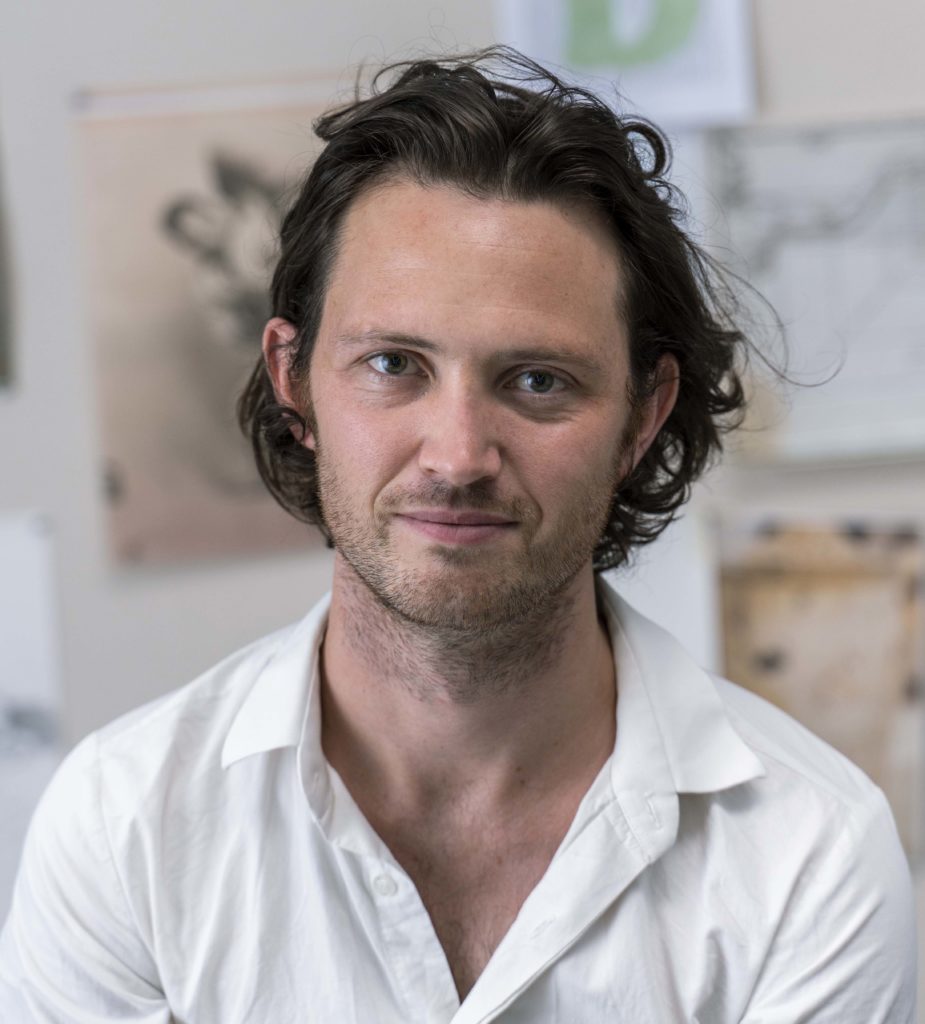
Sean Crossley is an Australian painter. His practice utilizes painting as a pragmatic tool to examine the friction between abstraction and realism, both within the discipline itself and the broader social landscape. Crossley’s work engages with painting’s historical continuum while treating the canvas as a conceptual object embedded in contemporary visual culture.
A foundational moment for his practice occurred during a residency at WIELS Contemporary Art Centre, where he developed a series of one hundred paintings, later compiled into his 2024 artist book, Excess/Support (MER. Books). This project established his approach to painting as a system of exchange: a reflexive, non-literal method for navigating the complexities of the information age. His process often begins with quotidian or conventional subjects (faces, objects, or public spaces) which are gradually woven into complex, fused compositions. Through the buildup of surfaces and the revelation of pentimenti, the work maps haphazard connections between disparate subject matters, creating an ongoing dialogue between bodies of work.
Born in 1987 in Melbourne, Crossley studied visual arts at the Royal Melbourne Institute of Technology and at the HKU University of the Arts in Utrecht. His work has been presented in solo and group exhibitions across Europe and Australia, including at the WIELS Contemporary Art Centre in Brussels, Campus Biotech in Geneva, Levey Kwok (fka Harlan Levey Projects) in Brussels, and FUTURES Gallery in Melbourne. He has participated in residencies at the WIELS Contemporary Art Centre (2019), the Embassy of Foreign Artists (Geneva, 2021), and the Cité Internationale des Arts (Paris, 2025). Crossley lives and works in Brussels.
Behind the practice:
"There was a time when Winnie and I deliberately stayed away from painting. My background was philosophy, literature, politics; hers, design. We both admired painting, but felt we lacked the historical and technical grounding to make meaningful judgments about it. Rather than pretend otherwise, we decided to listen and learn.
What I remember from the first years with Sean are the studio visits. They were never just about looking at paintings — they were conversations about what painting could be, what it had inherited, what it had lost, why it still mattered. Looking back, I think we were learning from him as much as anything. Sean's approach is deeply conceptual: before any paint gets applied, there's an enormous amount of thinking — reading, questioning, researching, doubting. That made painting accessible to us in a way it hadn't been before. The work was never simply about images or surfaces. It was about constructing a language.
Watching his vocabulary get built, slowly, through years of looking and revising, has been one of the great privileges of working with him."
- Harlan Levey