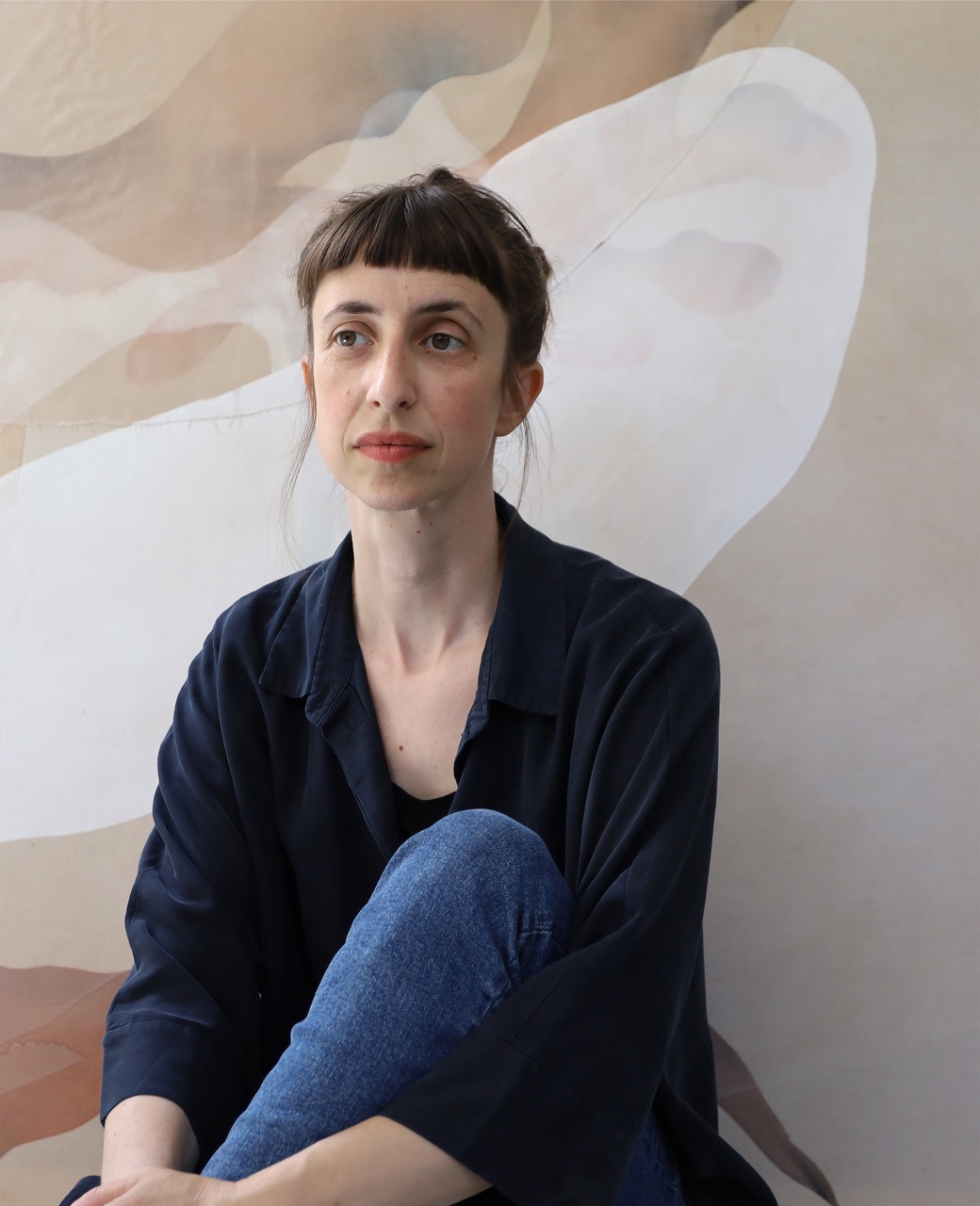
Amélie Bouvier is a French-Portuguese artist whose practice builds from historical research in the field of astronomy to question issues related to cultural memory and collective heritage. Scientists in general, and astronomers in particular, don’t only explain the world – they also represent it through diagrams, illustrations, photographs or equations. For Bouvier, scientific imagery is an extension of knowledge that reveals ideological and ethical frameworks, which risk cloaking aspects of the reality they aim to represent. She is particularly interested in the sky and stars as a landscape that exposes current socio-political contradictions and knowledge gaps. While her work is based on historical facts, data and visuals, she consistently mixes this with speculative imagery, adapting scientific tools and techniques to describe alternative, imagined realities.
Born in France in 1982, Bouvier trained at the Institut Supérieur des Arts Plastiques de Toulouse. Her work has been presented in solo and group exhibitions at institutions across Europe, Asia, and the Americas, including the Centre d'art de Colomiers, Aomori Contemporary Art Centre, Galeria Arsenał in Białystok, Museo Patio Herreriano in Valladolid, Centre Wallonie-Bruxelles Paris, and the Museo de Arte Prehispánico Rufino Tamayo in Oaxaca. In 2026, she was awarded the Special Jury Prize of the Prix COAL for her project Quadrivium – Orbital Pulse. She lives and works in Brussels, where she teaches drawing at the Royal Academy of Fine Arts.
Behind the practice:
"Not long after we first met, Amélie showed me a short film by Charles and Ray Eames called Powers of Ten. It begins with a couple having a picnic in a park. Every ten seconds the camera pulls back by another power of ten until the Earth disappears into the cosmos. Then it reverses direction, diving into the man's hand, through skin, cells, molecules and atoms. It remains one of the simplest and most brilliant films I've ever seen. I still think about it whenever I think about Amélie's work.
Her practice moves in this way, constantly shifting scale and perspective. In her work, the sky, stars, weather, light, geological time, historical archives, scientific data, forgotten technologies, all become part of the same conversation. She has a deep affection for history and for the quiet intelligence stored inside archives, but she is never interested in history as something complete. Instead, she places old records beside new observations, scientific knowledge beside acts of drawing, allowing different ways of understanding the world to illuminate one another.
Drawing remains at the centre of her practice, even as it continues to expand into video, kinetic sculpture and monumental textile works. Whatever form it takes, I still recognize the lesson she offered me all those years ago through Powers of Ten: sometimes the most profound discoveries don't come from changing the world, but from changing your perspective on it."
– Harlan Levey