“The work of Dutch artist Jeroen Jongeleen, otherwise known as Influenza, is characterized by a distinct stance of dissensus: one that opposes both the superficiality of urban design and the increasing colonisation of the street. In a practice that engages with images and public space in a militantly active way, he employs numerous methods and materials - including stickers, plastic bags, spray paints and even the human body itself - in an effort to enliven the banality and sterility of the modern city. Championing a more liberated public sphere and critiquing the over-regulation of both the city and art, Jongeleen’s understated but always ingenious urban interventions are heavily influenced by art movements such as Fluxus (a multidisciplinary group of avant-garde artists in the 1960’s), who he sees as the true descendants of the Dada spirit. He describes his motivation to create art as not about ‘decoration or making people happy, but about free speech and movement, about opposition as the essence of a truly democratic society’. His politically motivated work therefore sets out to illustrate the power and the dynamics of the street, while offering a utopian vision for the future.” - Rafael Schacter
Jeroen Jongeleen was born in 1967 in Apeldoorn, and studied in the AKI Academy for Art & Design, Enschede. His work has been featured in solo and group shows at international institutions including the Kröller-Müller Museum in Otterlo, the SCAPE Christchurch Biennial of Art in Public Space, and the Palais de Tokyo in Paris. His works are present in private and public collections such as the Museum Boijmans Van Beuningen in Rotterdam, the Museum Voorlinden in Wassenaar, and the Amsterdam Airport Schiphol. Jeroen Jongeleen lives and works in Rotterdam.
Behind the practice:
"Long before there was a gallery, there was Modart, where I was Editor-in-Chief — writing about artists, visiting studios, trying to understand where contemporary practice was heading. Jeroen Jongeleen was one of the artists I kept returning to.
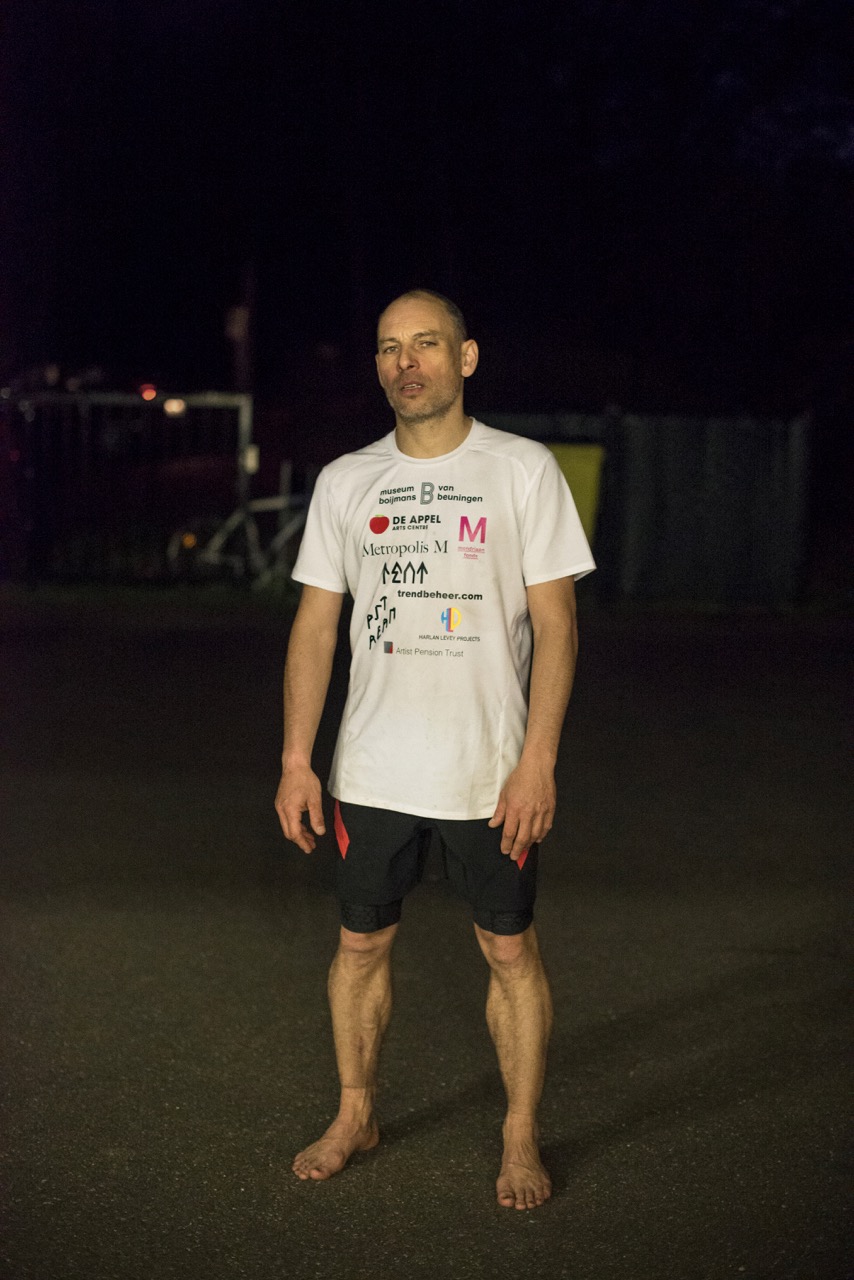
At the time, what was loosely called street art was starting to become something more complex, though none of us would have described it that way then. Looking back, I was fascinated by three trajectories. Shepard Fairey was the artist as entrepreneur — someone who understood circulation, branding, a visual language built to move beyond the street. Banksy understood narrative and media with an instinctive precision. Jeroen was something else entirely: a militant purist. His work reminded me less of graffiti than of Joseph Beuys — not visually, but in the belief system underneath it. The city was his studio. His body was his tool. Running became a way of drawing, measuring, questioning, claiming space.
By the time Winnie and I started the gallery, Jeroen was one of the first artists we wanted to work with — years of conversation had already built the trust that became the collaboration. One of the first things he ever told me about working with the gallery has stayed with me since. He said he'd be the salt and pepper: he'd add flavour, but he would never become the meat that sustained the programme.
We found it charming at the time, but beside the point — a gallery can't be built only around what it can sell. It has to be built around what it believes is worth protecting."
- Harlan Levey