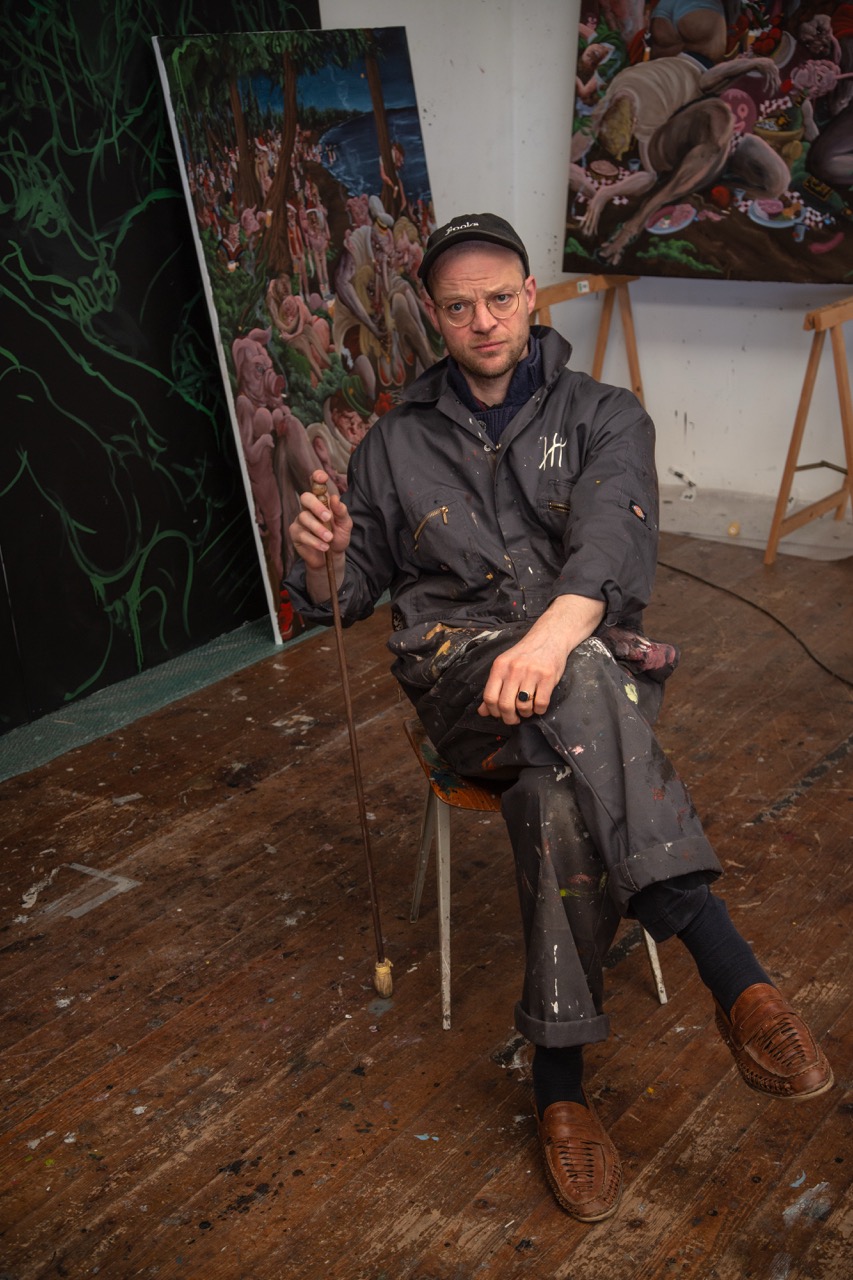
Willehad Eilers is a German painter and street artist who also works under the pseudonym Wayne Horse. His eclectic body of work is distinctive for its lyrical quality, playful humour, and expressiveness. Describing his practice as an investigation of the political and cultural mores that define contemporary society, Eilers gently nudges us towards a poetic realisation of our social selves through his highly performative range of paintings, installations, videos, and drawings. Infused with a mischievous, effortless confidence, Eilers’ crude-style works offer us anthropological insight into his observations of the flawed human condition and its perpetual evolution. He unflinchingly presents us with images that convey the disposition of the modern individual towards grotesque, even masturbatory obsessions. He assails the quotidian situations that we are familiar with and renders them unrecognisable.
Born in 1981 in Peine, Eilers began his career in the German graffiti scene, and later moved to Amsterdam, where he attended the Gerrit Rietveld Academie as well as the Rijksakademie van Beeldende Kunsten. His work has been presented in solo and group exhibitions at institutions across Europe and beyond, including the Museum Jan Cunen in Oss, The Institute of Contemporary Arts - ICA in London, the Stedelijk Museum in Breda, the Musée de l’Hospice Comtesse in Lille, the Centraal Museum in Utrecht, and the Venice Biennale. His video works have been screened at international festivals including Kasseler Dokfest, Internationale Kurzfilmtage Winterthur, Pictoplasma Berlin, and the Portland Underground Film Festival. Since 2018, he has been regularly publishing his zine, The Horse Diaries; in 2026, these zines were compiled into a volume, Sex Master, published by Éditions Lord Byron and launched at the Palais de Tokyo, Paris. Eilers lives and works in Amsterdam.
Behind the practice:
"For years, Willehad drew blindfolded. Literally — he'd cover his eyes and build rules that kept him from seeing the lines he was making, so that all he had was the movement of the hand, the pressure of the mark, the relationship between body and paper. People sometimes called the results drunken drawings, from how they looked. Willehad called them blind drawings: a way of breaking his own language apart in order to rebuild it.
He explained the problem plainly once: his work looked good, but it didn't always feel honest. There was a gap between what his hand could do and what he actually felt. He was, and remains, an exceptional draughtsman — but that very ability had become something he needed to question.
As Winnie and I were still figuring out what kind of gallery we wanted to become, Willehad kept challenging our assumptions. He worked across animation, experimental video, illustration, performance, never interested in staying inside one category. Even then, the same qualities were there — humor, intelligence, play, a willingness to make things uncomfortable.
In 2019, we brought some of the blind drawings to the Dallas Art Fair. There, Willehad met Philippe Mueller. They became friends almost immediately, and started painting on the same canvases. Willehad had never really worked in oil; Philippe was already a young master of it. What came out of the pairing had the energy of street culture — playful, unafraid of failure — but a sophistication that surprised them both: two visual languages overlapping, competing, merging into a shared universe of fantasy and dark humor. It's the moment Willehad's painting practice really began.
Looking back, we are reminded that the most meaningful developments, in this work, keep arriving from places you can't plan for."
- Harlan Levey